> ## Documentation Index
> Fetch the complete documentation index at: https://docs.levelset.io/llms.txt
> Use this file to discover all available pages before exploring further.
# Positions and ratings
> Set up the areas and positions your organization rates, the criteria for each position, who can rate whom, the color scale and whether every rating needs a comment
This page decides what a positional excellence rating is. A **position** is a spot a team member works during a shift, such as Front Counter or Breader (use your own position names), and each rated position carries up to five **criteria**, the things a person scores 1, 2 or 3 when they rate someone there. Positions sit in an **area**, a group such as Front of House, and the area decides who can rate in it. Where [Positional Excellence](/positional-excellence/overview) shows the ratings that come back, this page sets the rules they are given under. Everything here belongs to the whole organization, so every store rates on the same list.
Open **Performance > Set up > Positions and ratings**. It has three tabs: **Positions**, **Rating scale** and **Form settings**. Anyone who can sign in can open the page and read it; changing each part takes a permission, listed in [Who can do what](#who-can-do-what).
Say your store wants a Hospitality area for lobby work, with a Lobby Host position that only Team Leads and above can rate (use your own role names). The sections below build it.
## Areas
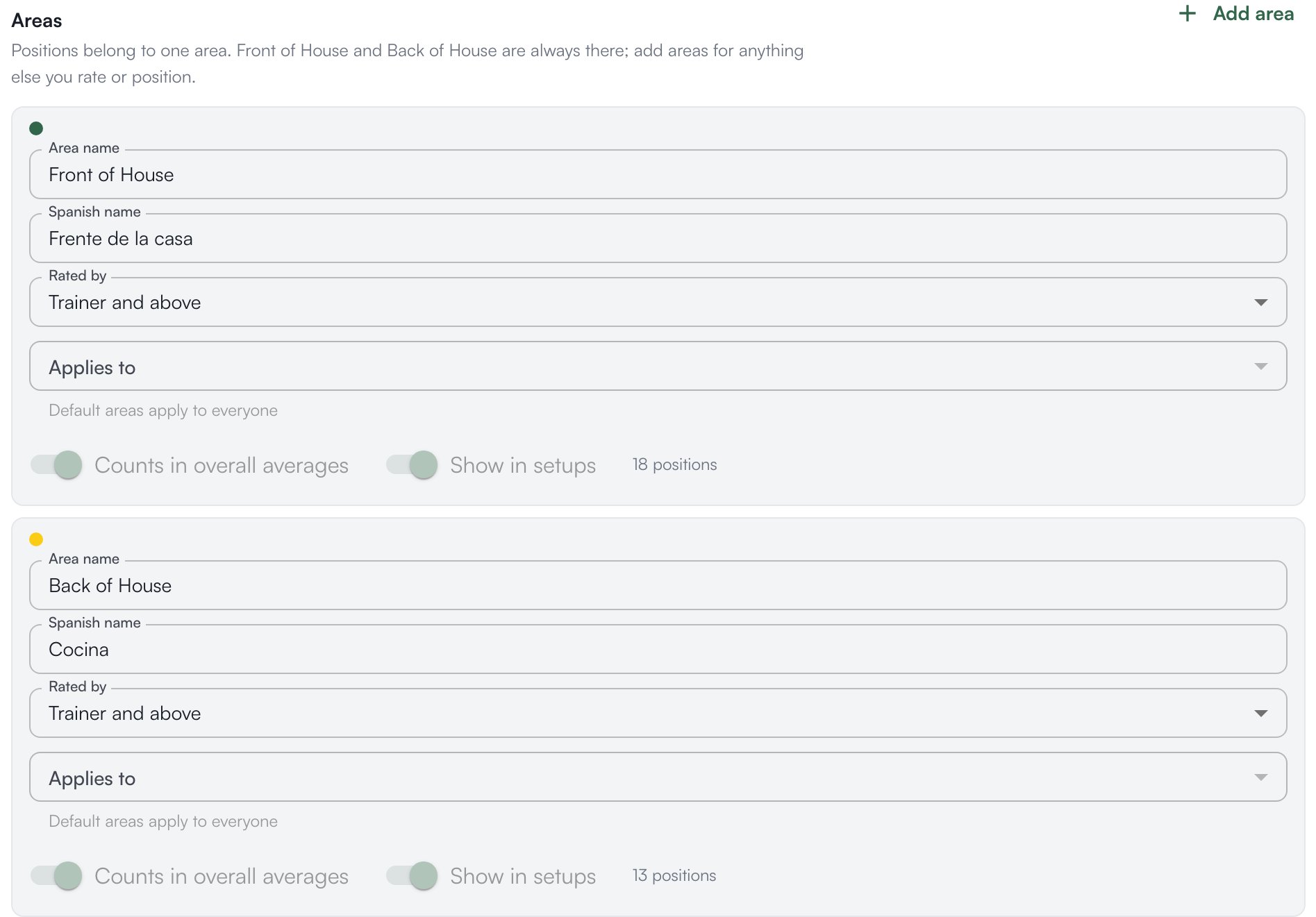
The **Positions** tab has two sub-tabs. On **Levelset positions**, **Areas** at the top lists your areas. Front of House and Back of House are always there. Click **Add area** for anything else you rate or plan setups for, Hospitality in the example, and give it an **Area name** and a **Spanish name**. Each area has four settings.
 | Setting | What it decides |
| - | - |
| **Rated by** | The lowest role that can rate in this area, shown as "Team Lead and above". Left on **Org default**, there is no minimum role unless Levelset has set a default for your organization |
| **Applies to** | Which roles can be rated here: **Everyone**, or one role and everyone above it, so a Leadership area can apply to Team Leads and up. The two default areas always apply to everyone |
| **Counts in overall averages** | Whether ratings here count toward a person's overall average. Always on for the two default areas |
| **Show in setups** | Whether the area appears in **Scheduling > Setups**, the plan of who works which position during a shift. Always on for the two default areas |
Areas you added have arrows to reorder them and a trash icon; the two default areas have neither. An area can be deleted only once every position has been moved out of it and no setup template or store layout still uses it.
## Add or edit a position
1. On **Levelset positions**, click **Add position** under the area it belongs to, Hospitality for Lobby Host, or click an existing position to expand it.
2. Enter the **Position name** and pick the **Area**. **Rated by (this position)** overrides the area's rule for this position only; leave it on inherit to follow the area.
3. Write a **Description** of what the position owns and what good work there looks like. It shows under the position on the rating form.
4. Turn on **Use for positional ratings** and write the criteria. Turn on **Show in Levelset scheduling** if the position should be available on the schedule and in setups; this switch takes Scheduling > Manage Scheduling Settings. A position can do one, both or neither.
5. Click **Save changes**. Leaving with unsaved edits asks whether to save, discard or keep editing.
The language dropdown switches the names and descriptions between **English** and **Español**. In Español, **Translate all positions** and a translate button on each position fill in the Spanish from the English. People see the language their form is set to.
## Write the criteria
Each rated position has up to five criteria. For each one, the **Criterion name** is the short label shown on the form, the **Description** says what to watch for, and **Rating guidance (1 / 2 / 3)** says what each score means for this criterion; a field left blank shows only the score's own name, **Not Yet**, **On the Rise** or **Crushing It**. Written guidance is what keeps two people from scoring the same work differently. **Pillar 1** and **Pillar 2** tag the criterion to a pillar, one of the parts of the operation the Pillars scores track; see [Pillars](/goals/pillars). **Allow N/A** lets the person rating mark the criterion Not Applicable when it can't be observed, and it then leaves the average.
| Setting | What it decides |
| - | - |
| **Rated by** | The lowest role that can rate in this area, shown as "Team Lead and above". Left on **Org default**, there is no minimum role unless Levelset has set a default for your organization |
| **Applies to** | Which roles can be rated here: **Everyone**, or one role and everyone above it, so a Leadership area can apply to Team Leads and up. The two default areas always apply to everyone |
| **Counts in overall averages** | Whether ratings here count toward a person's overall average. Always on for the two default areas |
| **Show in setups** | Whether the area appears in **Scheduling > Setups**, the plan of who works which position during a shift. Always on for the two default areas |
Areas you added have arrows to reorder them and a trash icon; the two default areas have neither. An area can be deleted only once every position has been moved out of it and no setup template or store layout still uses it.
## Add or edit a position
1. On **Levelset positions**, click **Add position** under the area it belongs to, Hospitality for Lobby Host, or click an existing position to expand it.
2. Enter the **Position name** and pick the **Area**. **Rated by (this position)** overrides the area's rule for this position only; leave it on inherit to follow the area.
3. Write a **Description** of what the position owns and what good work there looks like. It shows under the position on the rating form.
4. Turn on **Use for positional ratings** and write the criteria. Turn on **Show in Levelset scheduling** if the position should be available on the schedule and in setups; this switch takes Scheduling > Manage Scheduling Settings. A position can do one, both or neither.
5. Click **Save changes**. Leaving with unsaved edits asks whether to save, discard or keep editing.
The language dropdown switches the names and descriptions between **English** and **Español**. In Español, **Translate all positions** and a translate button on each position fill in the Spanish from the English. People see the language their form is set to.
## Write the criteria
Each rated position has up to five criteria. For each one, the **Criterion name** is the short label shown on the form, the **Description** says what to watch for, and **Rating guidance (1 / 2 / 3)** says what each score means for this criterion; a field left blank shows only the score's own name, **Not Yet**, **On the Rise** or **Crushing It**. Written guidance is what keeps two people from scoring the same work differently. **Pillar 1** and **Pillar 2** tag the criterion to a pillar, one of the parts of the operation the Pillars scores track; see [Pillars](/goals/pillars). **Allow N/A** lets the person rating mark the criterion Not Applicable when it can't be observed, and it then leaves the average.
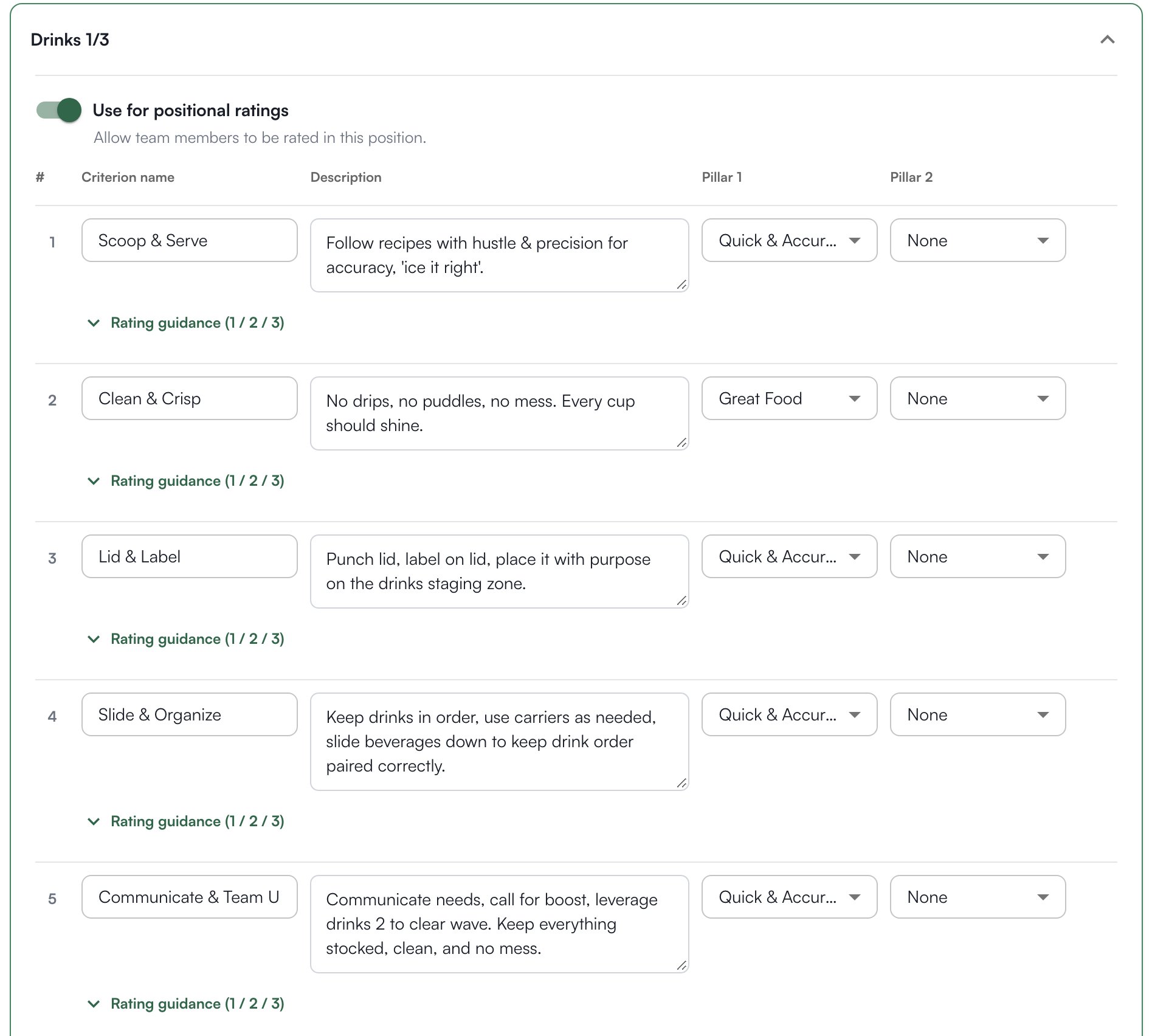 A position can be rated as soon as one criterion has a name. Until then it reads **Can't be rated yet: add criteria** and is not offered on the rating form.
Scores are stored by criterion slot, not by name. If you change what slot 3 measures, past scores in slot 3 show under the new label. Renaming is safe; to measure something new, use an empty slot.
## Archive a position
Positions are never deleted, because past ratings and shifts point at them. Expand the position, click the trash icon and confirm **Archive position**: it leaves the active lists and keeps its ratings, criteria and shifts. If a job from your scheduling system is still connected to it, unlink the job first.
## Connect your scheduling system's jobs
The second sub-tab of **Positions** lists the job names found in the schedules imported from your scheduling system, grouped by store, with a dropdown to connect each one to a Levelset position so imported shifts land on the right position. Connect a job only when it always means one position; a general job is better left unlinked. The dropdown can also create a matching Levelset position, made for scheduling only with ratings off. Jobs appear only after a schedule has been imported for that store. Connecting, unlinking and creating positions from jobs takes Scheduling > Manage Scheduling Settings; without it the jobs are listed read only.
## Set the color scale
On the **Rating scale** tab, ratings average between 1.0 and 3.0 and two cut-off points split that range into three bands: **Not Yet** up to the first, **On the Rise** up to the second, and **Crushing It** above it. The defaults are 1.75 and 2.75. Both must be between 1.0 and 3.0 with the first below the second, and they apply to the whole organization. These bands color every rating view and the setup, so set them where your standard is. **Save Changes** appears once you edit.
**Rating goals**, lower on the same tab, is how many ratings each role is expected to submit per week or month. Leave a role blank for no goal.
## Require a comment on every rating
The **Form settings** tab has one switch, **Require Additional Comments**. When it is on, a rating can't be submitted without a comment. It is off to start; turning it on gives you more to read back later and makes each rating take longer. Click **Save Changes**.
## Who can do what
If a control described on this page is read only for you, this table names the permission behind it.
| If you notice this | The permission behind it |
| - | - |
| Areas and positions open but their names, areas, descriptions and **Rated by** can't be changed, and positions can't be added or archived | Positional Excellence > Manage Positions |
| The **Show in Levelset scheduling** switch and the job dropdowns on the second sub-tab are read only | Scheduling > Manage Scheduling Settings |
| The criteria fields are read only | Positional Excellence > Manage Rating Criteria |
| The **Rating scale** and **Form settings** tabs are read only | Positional Excellence > Manage Rating Scale |
If you're missing something here, ask whoever manages roles in your organization to turn it on. See [Roles](/team/roles).
## Common questions
Check that **Use for positional ratings** is on and at least one criterion has a name.
Their role is below that area's **Rated by** role, or below the position's own **Rated by (this position)**. Lower the setting, or ask whoever manages roles in your organization whether their role is right.
Not here. On **Performance > Positional Excellence**, the **SmartView** tab has a trash icon on each rating's row. A rating can't be edited, only deleted. See [Delete a rating](/positional-excellence/overview#delete-a-rating).
No. A position has five criterion slots. Fill the ones you use and leave the rest blank; a blank slot is not shown on the form.
A position can be rated as soon as one criterion has a name. Until then it reads **Can't be rated yet: add criteria** and is not offered on the rating form.
Scores are stored by criterion slot, not by name. If you change what slot 3 measures, past scores in slot 3 show under the new label. Renaming is safe; to measure something new, use an empty slot.
## Archive a position
Positions are never deleted, because past ratings and shifts point at them. Expand the position, click the trash icon and confirm **Archive position**: it leaves the active lists and keeps its ratings, criteria and shifts. If a job from your scheduling system is still connected to it, unlink the job first.
## Connect your scheduling system's jobs
The second sub-tab of **Positions** lists the job names found in the schedules imported from your scheduling system, grouped by store, with a dropdown to connect each one to a Levelset position so imported shifts land on the right position. Connect a job only when it always means one position; a general job is better left unlinked. The dropdown can also create a matching Levelset position, made for scheduling only with ratings off. Jobs appear only after a schedule has been imported for that store. Connecting, unlinking and creating positions from jobs takes Scheduling > Manage Scheduling Settings; without it the jobs are listed read only.
## Set the color scale
On the **Rating scale** tab, ratings average between 1.0 and 3.0 and two cut-off points split that range into three bands: **Not Yet** up to the first, **On the Rise** up to the second, and **Crushing It** above it. The defaults are 1.75 and 2.75. Both must be between 1.0 and 3.0 with the first below the second, and they apply to the whole organization. These bands color every rating view and the setup, so set them where your standard is. **Save Changes** appears once you edit.
**Rating goals**, lower on the same tab, is how many ratings each role is expected to submit per week or month. Leave a role blank for no goal.
## Require a comment on every rating
The **Form settings** tab has one switch, **Require Additional Comments**. When it is on, a rating can't be submitted without a comment. It is off to start; turning it on gives you more to read back later and makes each rating take longer. Click **Save Changes**.
## Who can do what
If a control described on this page is read only for you, this table names the permission behind it.
| If you notice this | The permission behind it |
| - | - |
| Areas and positions open but their names, areas, descriptions and **Rated by** can't be changed, and positions can't be added or archived | Positional Excellence > Manage Positions |
| The **Show in Levelset scheduling** switch and the job dropdowns on the second sub-tab are read only | Scheduling > Manage Scheduling Settings |
| The criteria fields are read only | Positional Excellence > Manage Rating Criteria |
| The **Rating scale** and **Form settings** tabs are read only | Positional Excellence > Manage Rating Scale |
If you're missing something here, ask whoever manages roles in your organization to turn it on. See [Roles](/team/roles).
## Common questions
Check that **Use for positional ratings** is on and at least one criterion has a name.
Their role is below that area's **Rated by** role, or below the position's own **Rated by (this position)**. Lower the setting, or ask whoever manages roles in your organization whether their role is right.
Not here. On **Performance > Positional Excellence**, the **SmartView** tab has a trash icon on each rating's row. A rating can't be edited, only deleted. See [Delete a rating](/positional-excellence/overview#delete-a-rating).
No. A position has five criterion slots. Fill the ones you use and leave the rest blank; a blank slot is not shown on the form.