

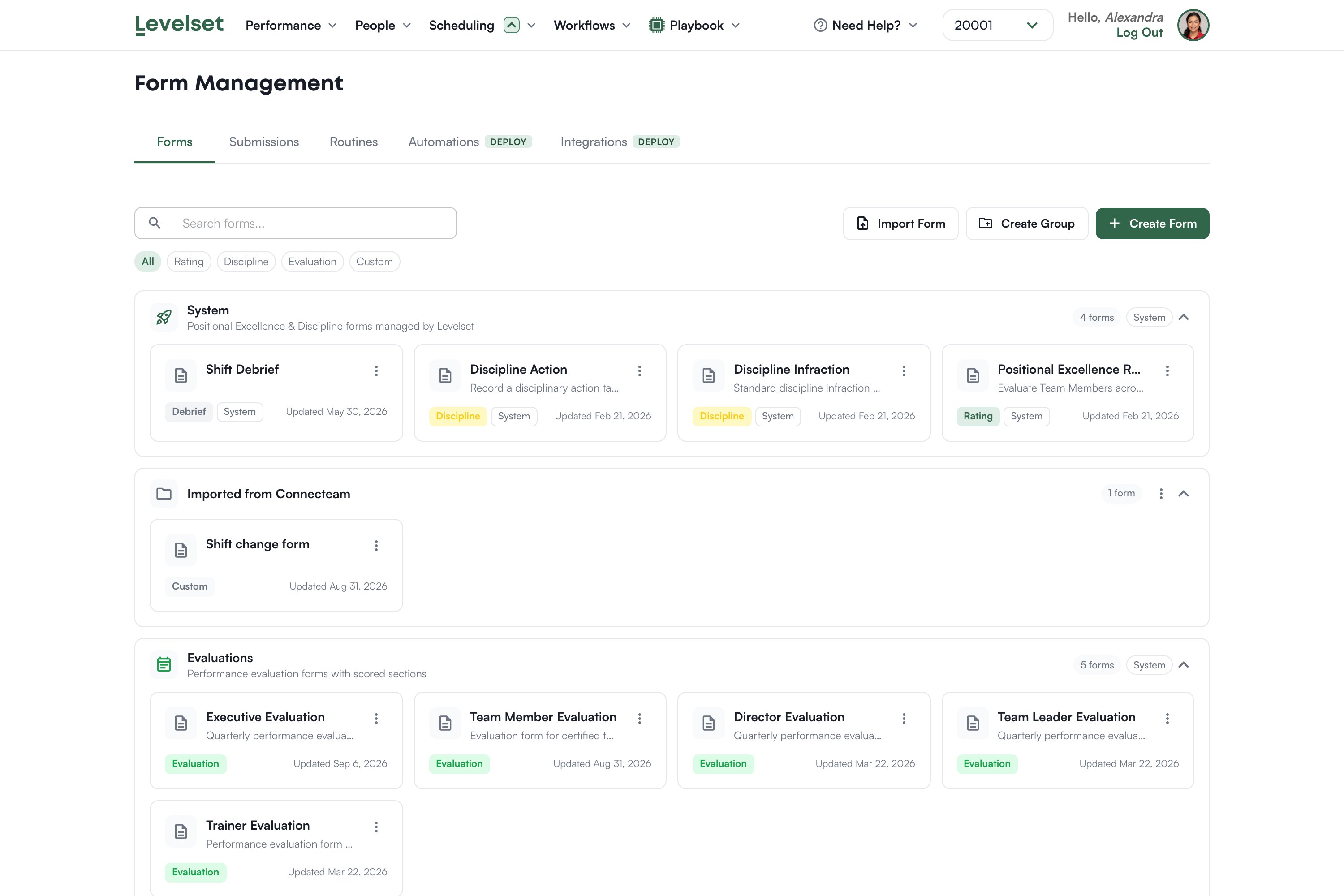
The tabs
Forms is your library. Submissions is what has been filled in. Routines puts a form on a schedule, covered in Routines. Automations and Integrations are part of the Deploy plan and carry a badge saying so.Form groups decide the form type
This is the one thing to understand before you build anything, because it causes a specific and confusing failure. Every form has a type, and the type comes from the group you create it in. The rule is mechanical:
Positional Excellence and Discipline groups do not accept new forms at all, because those forms are managed by Levelset.
The type then decides where the form can be used. Routines only offer custom forms. So a checklist built inside an Evaluations group is an evaluation, never appears when you create a routine, and nothing explains why.
If you already made this mistake, you do not have to rebuild. Move the form into an ordinary group and confirm when Levelset asks about changing its type.
Building a form
Open a form to edit it. Add fields, name them, mark them required or optional, and order them. There is a wide range of field types, including short and long text, numbers with minimum and maximum values, single and multiple choice, dates, signatures, and photo capture. Numeric ranges and photo proof are what make a checklist worth reading later: “fridge temperature 37” and a picture beats “yes, checked”. Write questions the way you would ask them on the floor. A form nobody finishes is worse than no form.Editing a form that already has submissions
You can change a form freely, including changing a field’s type, and past submissions are safe: each one keeps a copy of the form as it was when it was filled in, so old records still read correctly. If a change would lose something, for example turning a multiple choice into a number, Levelset warns you and lists what goes.Submissions
The Submissions tab lists what has come in, and opening one shows the answers as submitted.How many forms you get
The Measure plan includes up to 10 custom forms. Deploy removes the limit. If you are at the cap, either retire a form you no longer use or talk to your Levelset representative.System forms
Some forms ship with Levelset and power the built-in flows: the positional rating form and the discipline form your leaders use during a shift. They are managed by Levelset rather than built by you, and they are configured through Positional Excellence settings and Discipline settings rather than in the form editor.Common questions
My new form does not show up when I create a routine.
My new form does not show up when I create a routine.
Its group gave it a type routines exclude, almost always because the dialog defaulted to the Evaluations group. Move the form to an ordinary group and confirm the type change when asked. If the picker says there are no custom forms available, that is the same problem.
Who can build forms?
Who can build forms?
People whose permission level includes the Form Management permissions. View, create, edit and delete are separate switches. See Permissions.
Can I change a question after people have answered it?
Can I change a question after people have answered it?
Yes. Every submission stores the form as it was at the time, so past records still read correctly. Levelset warns you if a particular change would lose data.
Where do people fill these in?
Where do people fill these in?
Scheduled forms reach the person through Routines, on the same device your leaders use for ratings and discipline.